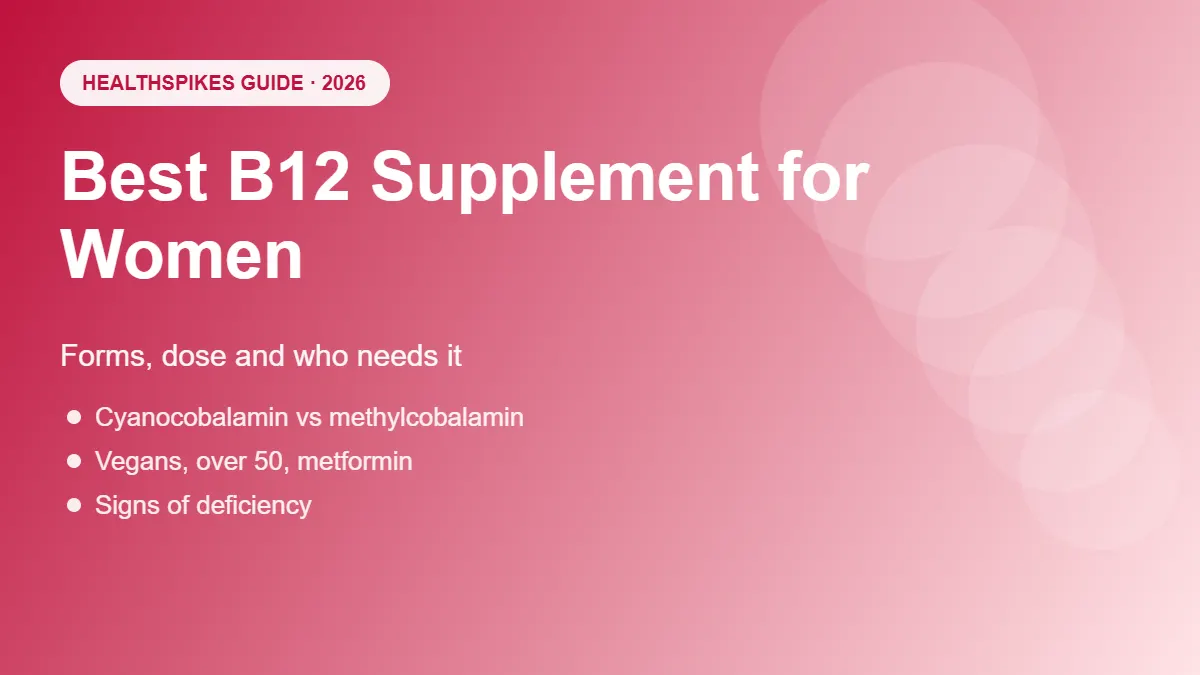
Vitamin B12 is essential for nerves, red blood cells and DNA. Women need 2.4 mcg a day (2.6 in pregnancy, 2.8 when breastfeeding). A B12 supplement is especially important for vegans, women over 50, people taking metformin or acid-reducing medicines, and those with stomach or gut conditions. Both cyanocobalamin and methylcobalamin work; cyanocobalamin is the most studied and stable.
Key takeaways
- Women need 2.4 mcg of B12 a day; more in pregnancy and breastfeeding.
- Vegans, women over 50 and metformin users are at higher risk of deficiency.
- Cyanocobalamin is well studied; methylcobalamin is also effective.
- Oral doses of 250–1,000 mcg can correct many deficiencies; injections may be needed.
- Deficiency can cause fatigue, numbness and memory problems.
- Women who are vegan, over 50, pregnant or taking metformin or acid reducers are the most likely to benefit from a B12 supplement.
Who needs a B12 supplement?
- Vegans and many vegetarians
- Women over 50 (lower stomach acid reduces absorption)
- People taking metformin or long-term PPIs/H2 blockers
- After weight-loss surgery
- Pernicious anemia
- Crohn’s or celiac disease
B12 supplement forms
| Form | Notes |
|---|---|
| Cyanocobalamin | Most studied, stable, inexpensive |
| Methylcobalamin | Active form; effective |
| Adenosylcobalamin | Often combined with methyl |
| Hydroxocobalamin | Used in injections |
Signs of B12 deficiency
- Fatigue and weakness
- Numbness or tingling in hands and feet (see neuropathy)
- Memory problems and low mood
- Sore tongue
- Large red blood cells on blood tests (see high MCV)
How much to take
For prevention in at-risk groups, 25–250 mcg daily or 1,000 mcg a few times a week is common. For deficiency, doctors often prescribe 1,000–2,000 mcg orally daily or injections. B12 has no upper limit because excess is excreted, but very high doses are rarely needed.
Food sources
Meat, fish, eggs, dairy, and fortified cereals and plant milks. See best multivitamin for women for combined options.
B12 supplement forms compared in detail
| Form | What it is | Pros | Cons |
|---|---|---|---|
| Cyanocobalamin | Synthetic, most studied | Stable, cheap, works well for most people | Tiny amount of cyanide released (harmless at supplement doses) |
| Methylcobalamin | Natural active form | Widely available; no conversion step | Less stable; less research on correcting deficiency |
| Adenosylcobalamin | Natural active form | Often combined with methyl form | More expensive, limited data |
| Hydroxocobalamin | Used in injections | Stays in the body longer | Mostly by prescription |
For most women, cyanocobalamin is a reliable and affordable choice. If you prefer methylcobalamin, it is also a reasonable option. The best B12 supplement is one you take consistently at the right dose.
Why women over 50 and pregnant women need extra attention
As we age, the stomach makes less acid, which is needed to release B12 from food protein. That is why the U.S. National Academy of Medicine advises people over 50 to get most of their B12 from fortified foods or a B12 supplement, because the free form does not need stomach acid to be absorbed.
During pregnancy and breastfeeding, B12 needs rise to 2.6 and 2.8 mcg a day. Low B12 in pregnancy has been linked to neural tube problems and developmental issues in babies, particularly in vegan and vegetarian mothers. Most prenatal vitamins contain B12, but check the amount if you do not eat animal foods.
Medicines that lower B12
- Metformin, used for type 2 diabetes and PCOS. Long-term users should have B12 checked regularly.
- Proton pump inhibitors (omeprazole, esomeprazole and others) and H2 blockers taken for more than two years.
- Some anticonvulsants and long-term nitrous oxide exposure.
- Colchicine.
If you take one of these, ask your doctor whether you need a B12 test or a B12 supplement.
Sublingual, tablet, spray or injection?
Sublingual tablets, regular tablets, gummies and sprays all work for most people because at high doses, about 1 percent of B12 is absorbed by passive diffusion without needing intrinsic factor. Studies show that high-dose oral B12 (1,000 to 2,000 mcg a day) can correct deficiency as well as injections in many people. Injections are still preferred for severe deficiency with nerve symptoms, pernicious anemia in some cases, or after certain types of stomach or bowel surgery.
How to choose a quality B12 supplement
- Look for third-party testing seals such as USP Verified, NSF Certified or Informed Choice.
- Check the dose: 250 to 1,000 mcg a day is common for prevention; your doctor may advise more for deficiency.
- Avoid products that make big claims about energy or weight loss; B12 only boosts energy if you are deficient.
- If you are vegan, choose one labeled vegan, since some capsules contain gelatin.
- Watch out for added sugars in gummies.
Is too much B12 harmful?
B12 has no established upper limit because it has low toxicity; extra is generally excreted in urine. Some people notice acne or mild stomach upset with very high doses. A very high blood B12 level without supplements can sometimes point to liver or blood disorders, so mention it to your doctor if it appears on a test you did not expect.
Related guides
Frequently asked questions
Which form of B12 is best?
Both cyanocobalamin and methylcobalamin work.
Can you take too much B12?
There is no upper limit, but very high doses are rarely needed.
Do I need B12 if I eat meat?
Usually not, unless you have absorption problems.
How long until B12 works?
Energy may improve in weeks; nerve symptoms take longer.
Should I test before taking B12?
Testing helps if you have symptoms.
When is the best time to take a B12 supplement?
Morning or early in the day is popular, but timing does not matter much. Consistency is more important.
How long does a B12 supplement take to work?
People who are deficient often feel better within a few weeks, while nerve symptoms can take months to improve.
Can I get enough B12 from a multivitamin?
Often yes for prevention, if it contains at least the daily need. People with absorption problems usually need a separate higher dose.
Medical disclaimer: This article is for general information and is not a substitute for advice from your doctor or another qualified health professional. See our medical disclaimer and editorial policy.