Vitamin D helps your body absorb calcium, keeps bones strong and supports muscles, nerves and the immune system. Your skin makes it from sunlight, but in winter, at higher latitudes, or if you spend most of your time indoors, food becomes much more important. The challenge is that only a small number of foods are naturally rich in it. This guide ranks the best foods high in vitamin D, using figures from the NIH Office of Dietary Supplements and USDA, and explains how to build a diet that meets your needs.
You will also learn how much you need at each age, which plant-based foods high in vitamin D work for vegans, and when a blood test or supplement is the better choice.
Key takeaways
- Oily fish such as trout, salmon, sardines and herring are the richest natural foods high in vitamin D.
- Mushrooms exposed to UV light are one of the few good plant sources.
- Fortified milk, plant milks, orange juice and cereals provide much of the vitamin D in many diets.
- Most adults need 600 IU (15 mcg) a day, rising to 800 IU after age 70.
- It is hard to get enough from food alone, so sunlight and sometimes supplements matter.
Chart: 15 foods high in vitamin D
Values are approximate and vary by brand, species and how the food is prepared. Percent Daily Value (DV) is based on 800 IU (20 mcg).
| Food | Serving | Vitamin D (IU) | % DV |
|---|---|---|---|
| Cod liver oil | 1 tablespoon | About 1,360 | 170% |
| Rainbow trout, farmed, cooked | 3 oz (85 g) | About 645 | 81% |
| Sockeye salmon, cooked | 3 oz | About 570 | 71% |
| Swordfish, cooked | 3 oz | About 566 | 71% |
| White mushrooms, UV-exposed | Half cup | About 366 | 46% |
| Atlantic herring | 3 oz | About 180 | 23% |
| Fortified milk (2%) | 1 cup | About 120 | 15% |
| Fortified soy, almond or oat milk | 1 cup | About 100–144 | 13–18% |
| Fortified orange juice | 1 cup | About 100 | 13% |
| Fortified breakfast cereal | 1 serving | About 80 | 10% |
| Sardines, canned in oil | 2 sardines | About 46 | 6% |
| Egg, large, scrambled | 1 egg | About 44 | 6% |
| Beef liver, cooked | 3 oz | About 42 | 5% |
| Tuna, canned light | 3 oz | About 40 | 5% |
| Cheddar cheese | 1.5 oz | About 17 | 2% |
Sources: NIH Office of Dietary Supplements vitamin D fact sheet and USDA FoodData Central. Wild salmon often contains more vitamin D than farmed salmon, but values vary widely.
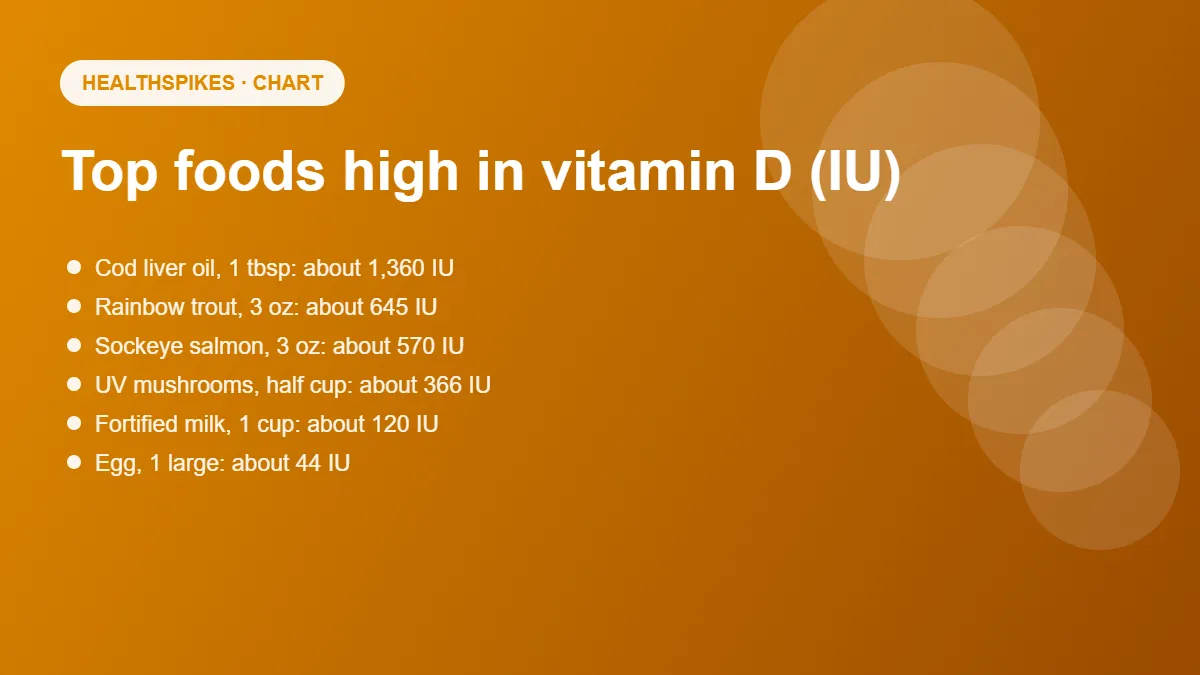
Fish and seafood: the strongest foods high in vitamin D
Fatty fish store vitamin D in their oil, which is why they top every list of foods high in vitamin D. Two servings of oily fish a week, as recommended by many heart health guidelines, can go a long way toward your weekly vitamin D needs while also providing omega-3 fats.
- Trout: farmed rainbow trout is one of the most reliable sources and is often cheaper than salmon.
- Salmon: sockeye and wild salmon are especially rich. Canned salmon with bones adds calcium too.
- Sardines and herring: affordable, sustainable and easy to keep in the pantry.
- Tuna: canned light tuna provides a modest amount; limit albacore because of its higher mercury content.
- Cod liver oil: very concentrated, but also high in vitamin A, so do not take more than the label advises, especially during pregnancy.
Eggs, dairy and fortified foods
Egg yolks contain vitamin D, and eggs from hens raised outdoors or fed vitamin D-enriched feed can contain several times more. Most cheese and yogurt contain little unless fortified. In the United States, most cow’s milk is fortified with vitamin D, and many plant milks, orange juices, yogurts and breakfast cereals are fortified too. Fortification rules differ by country, so check labels: in some countries milk is not routinely fortified.
Fortified foods are among the most practical foods high in vitamin D for children and for people who do not eat fish.
Vegan and vegetarian foods high in vitamin D
Plant foods naturally contain very little vitamin D, with one notable exception: mushrooms. Like human skin, mushrooms make vitamin D when exposed to ultraviolet light. Mushrooms sold as “UV-treated” or “high in vitamin D” can provide a large share of daily needs. You can even place sliced mushrooms in direct midday sun for 15 to 60 minutes to boost their content, although results vary.
- UV-exposed mushrooms (vitamin D2).
- Fortified plant milks and yogurts.
- Fortified orange juice.
- Fortified cereals and some tofu brands.
- Vegan vitamin D3 supplements made from lichen, or vitamin D2 supplements.
Vitamin D2 (from plants and fungi) and vitamin D3 (from animals and lichen) both raise blood levels, though D3 may raise and maintain levels slightly more effectively.
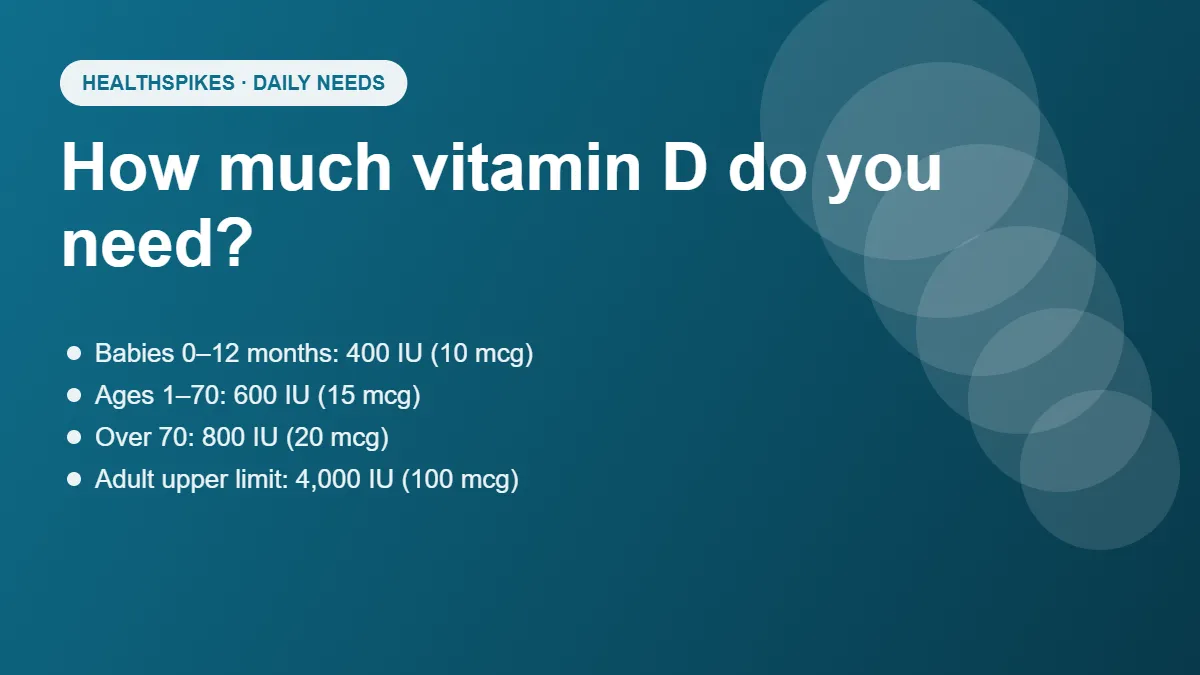
How much vitamin D do you need?
| Age group | Recommended daily amount | Upper limit |
|---|---|---|
| 0–12 months | 400 IU (10 mcg) | 1,000–1,500 IU |
| 1–13 years | 600 IU (15 mcg) | 2,500–3,000 IU |
| 14–70 years | 600 IU (15 mcg) | 4,000 IU |
| Over 70 | 800 IU (20 mcg) | 4,000 IU |
| Pregnancy and breastfeeding | 600 IU (15 mcg) | 4,000 IU |
These are U.S. National Academy of Medicine values. The UK recommends 10 mcg (400 IU) a day for everyone over age 1, especially in autumn and winter.
Sample day of eating foods high in vitamin D
- Breakfast: fortified cereal with fortified milk (about 200 IU) plus a scrambled egg (44 IU).
- Lunch: salad with a can of sardines or a tuna sandwich (40–90 IU).
- Snack: a glass of fortified orange juice or soy milk (about 100 IU).
- Dinner: baked trout or salmon (570–645 IU) with sautéed UV-exposed mushrooms.
A day like this can provide 1,000 IU or more, but most people will not eat this way every day, which is why sunlight and supplements often fill the gap.
Sunlight, absorption and supplements
For many people, sunlight provides most of their vitamin D. Exposing arms and legs to midday sun for short periods a few times a week can produce a meaningful amount in summer, but production falls sharply in winter at latitudes far from the equator, with darker skin, with age, and with sunscreen use. Balance sun exposure with skin cancer risk.
Vitamin D is fat-soluble, so eating foods high in vitamin D with some fat, or taking supplements with a meal, may improve absorption. If you are in a high-risk group or have symptoms like bone pain or muscle weakness, ask your doctor about a vitamin D 25-hydroxy test before taking high doses.
Who is most at risk of low vitamin D?
- Breastfed infants who do not receive a vitamin D supplement.
- Older adults, whose skin makes less vitamin D.
- People with darker skin.
- People who are housebound or cover most of their skin.
- People with obesity or who have had gastric bypass surgery.
- People with Crohn disease, celiac disease or liver or kidney disease.
Tips to get more from foods high in vitamin D
- Keep canned salmon, sardines and trout in the pantry for quick meals.
- Choose milk, plant milk and juice labeled “fortified with vitamin D”.
- Buy mushrooms labeled UV-treated, or sun them yourself before cooking.
- Eat the whole egg; the vitamin D is in the yolk.
- Pair foods high in vitamin D with calcium-rich foods for bone health.
- Bake, grill or steam fish rather than deep-frying.
Vitamin D, calcium and bone health
Vitamin D and calcium work as a team. Without enough vitamin D, the gut absorbs only a small fraction of the calcium you eat, and the body pulls calcium from bones to keep blood levels steady. Over time, this can lead to osteomalacia (soft bones) in adults and rickets in children, and it contributes to osteoporosis. Combining foods high in vitamin D with calcium sources such as dairy, fortified plant milks, tofu set with calcium, canned fish with bones and leafy greens like kale supports stronger bones at every age.
Can you get too much vitamin D?
It is almost impossible to get too much vitamin D from food or sunlight. Toxicity usually comes from taking very high-dose supplements for a long time, often more than 10,000 IU a day. Symptoms include nausea, vomiting, weakness, confusion, kidney stones and high blood calcium. Stick to the upper limit of 4,000 IU a day for adults unless your doctor prescribes more to treat a deficiency.
Related guides
- Vitamin D 25-Hydroxy Test Explained
- Best Multivitamin for Women
- How to Boost Your Immune System
- High-Fiber Foods List
Frequently asked questions
Which fruit is high in vitamin D?
No fruit is naturally high in vitamin D. Fortified orange juice is the main fruit-based source.
Are eggs one of the best foods high in vitamin D?
Eggs provide a modest amount, mostly in the yolk. Fish and UV mushrooms provide much more per serving.
Can you get enough vitamin D from food alone?
It is possible with regular oily fish and fortified foods, but many people fall short, especially in winter.
Does cooking destroy vitamin D?
Vitamin D is fairly heat-stable, but some is lost with long cooking or frying. Baking and steaming keep most of it.
What are the signs of low vitamin D?
Severe deficiency can cause bone pain, muscle weakness and, in children, rickets. Mild deficiency often has no symptoms.
What vegetables are foods high in vitamin D?
Only UV-exposed mushrooms provide meaningful amounts. Other vegetables contain little or none.
Medical disclaimer: This article is for general information and is not a substitute for advice from your doctor or another qualified health professional. See our medical disclaimer and editorial policy.